Workspace Planning
Office space planning for efficient layouts, team zoning, circulation logic, and scalable workplace strategy.

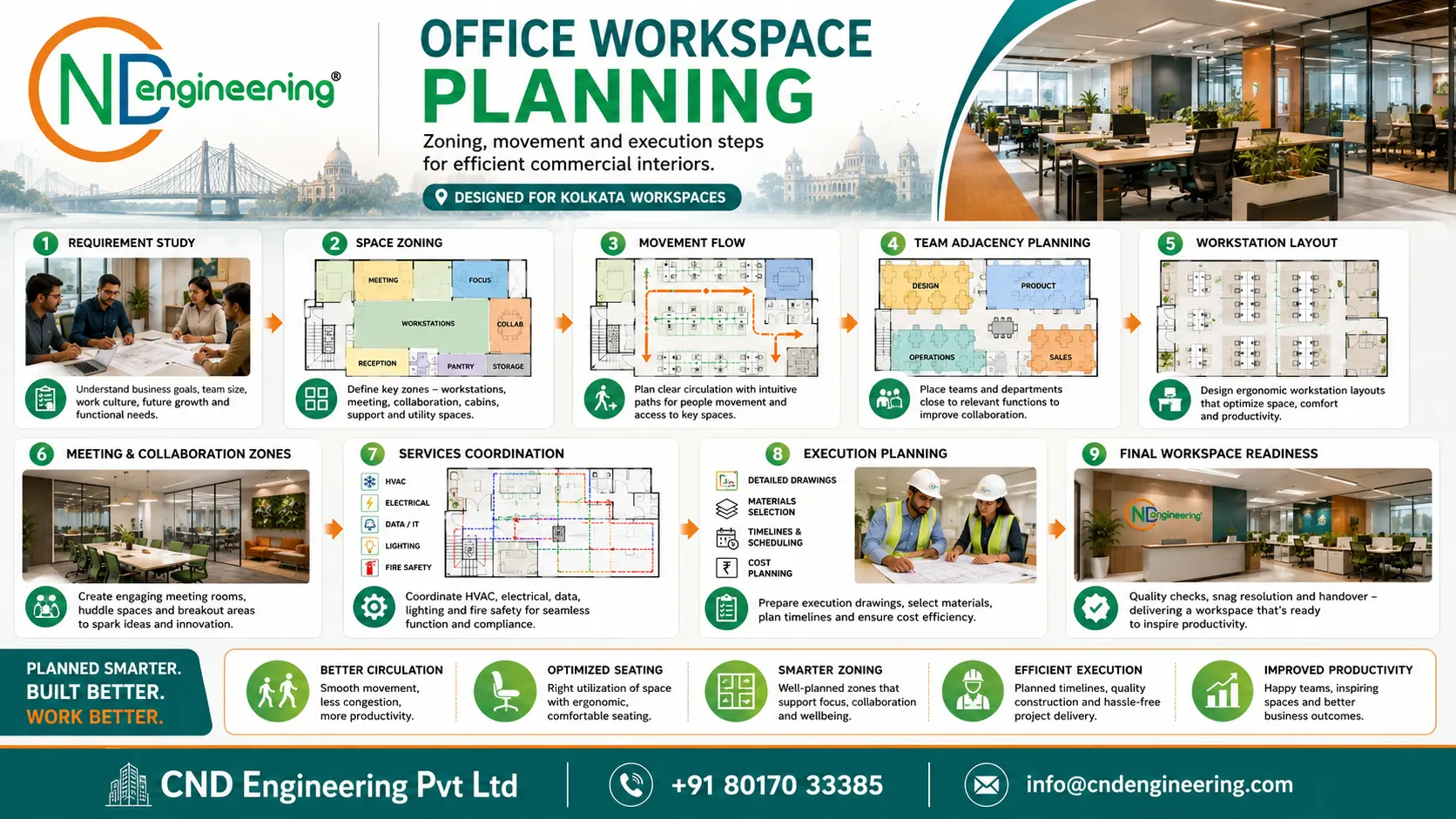
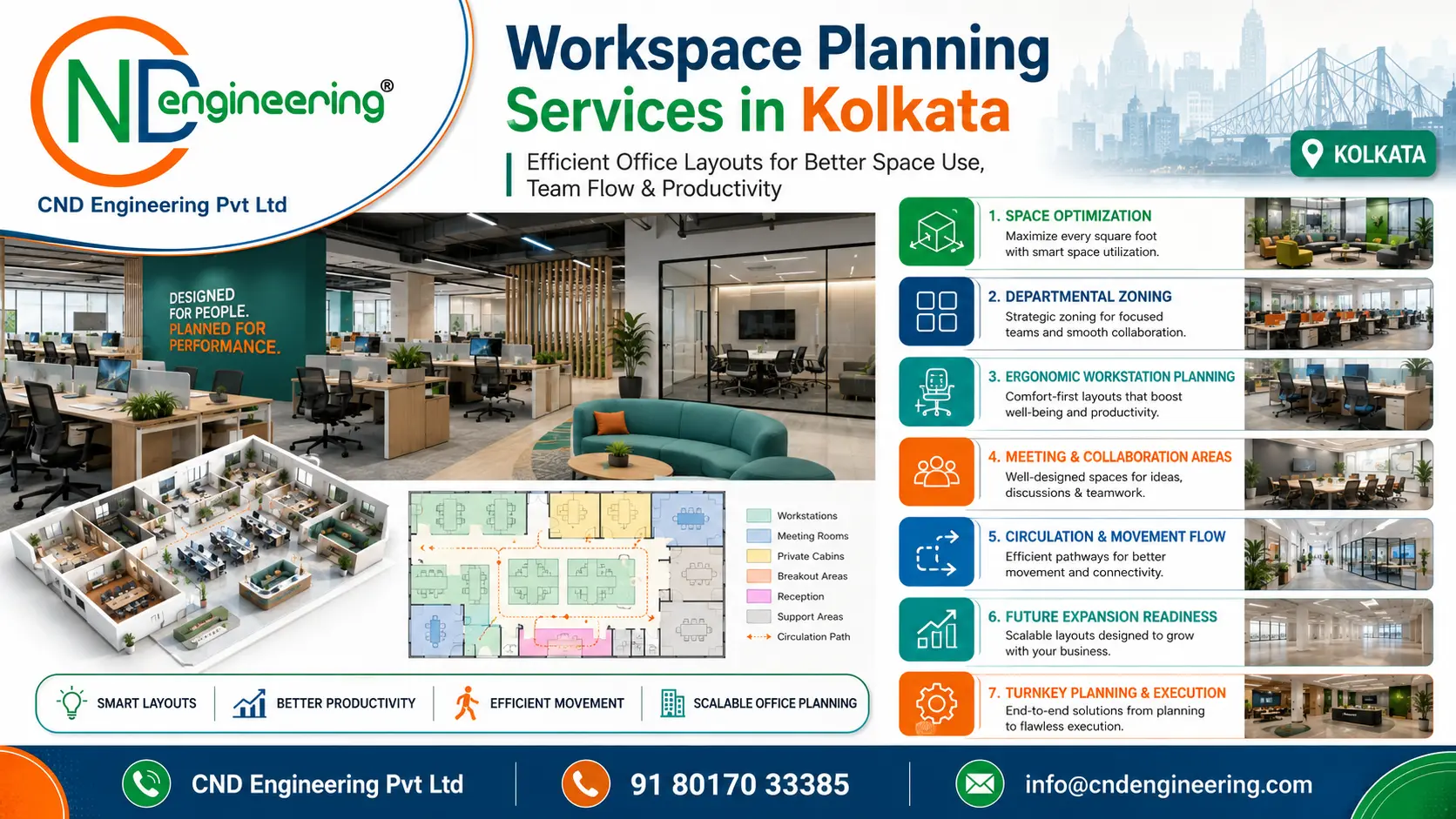
Workspace planning explains why layout intelligence should sit at the center of every office project. A beautiful office that wastes area, creates poor circulation, or ignores departmental relationships becomes expensive over time. A well-planned office, by contrast, improves usability, comfort, flexibility, and business performance.
We treat workspace planning as a professional discipline, not a side note to decoration. It explores how seat counts, functional adjacencies, privacy needs, movement patterns, and future growth all shape the final interior result.
It also supports valuable search themes such as office space planning, workspace interior design, and open office layout design.
Planning starts with business operations
Every office has a working rhythm. Some teams receive visitors all day. Some require quiet concentration. Some collaborate constantly. Some need secure records or high privacy. Workspace planning begins by reading these operating conditions and turning them into spatial logic.
That process may involve identifying which teams should sit near each other, how often meeting rooms are needed, how circulation should flow from entry to work areas, where acoustic buffers are required, and how support spaces should be distributed. None of this is glamorous in itself, but it is the foundation of a workplace that functions well.
By explaining planning this way, we show why early-stage layout work creates real value.
Seat density, comfort, and future flexibility
A common commercial challenge is fitting enough people into the office without making the space feel cramped or chaotic. Good workspace planning is not about maximum density alone. It is about finding a workable density that supports comfort, movement, power access, storage, and supervision without turning the office into a maze of compromises.
This service emphasizes that balance. It also addresses the need for future flexibility. Businesses grow, teams shift, and usage patterns change. A strong plan keeps expansion and reconfiguration in mind from the beginning. Modular workstations, movable partitions, and strategic service placement can make the office easier to adapt later.
That future-oriented thinking adds real business value and helps justify planning-led design decisions.
Circulation planning
Ensure staff and visitors can move easily through the office without crossing sensitive work zones unnecessarily.
Privacy gradients
Use layout, partitions, and spatial sequencing to move from public zones to semi-private and private zones naturally.
Expandable logic
Plan furniture and zones so the workplace can scale as the team grows.
Collaboration, focus, and hybrid work behavior
Modern offices need a wider range of settings than older workplace models. Pure rows of desks are rarely enough. Teams may need quick stand-up points, informal discussion corners, enclosed focus rooms, training spaces, quiet booths, or flexible collaboration areas that adapt during the week.
Workspace planning responds directly to these realities. It positions planning as the way to reconcile collaboration with focus, visibility with privacy, and brand presence with employee comfort. This makes the site feel current and aligned with how offices are actually used today.
It also helps the company sound more consultative. A planning-led office interior company is more valuable than one that simply fills a floor with furniture.
How planning supports cost efficiency
Many clients do not initially connect good planning with cost efficiency, but the connection is strong. When the layout is resolved early, it becomes easier to estimate furniture quantities, partition lengths, lighting distribution, flooring zones, and storage requirements accurately. That means fewer surprises later and better budget control.
Planning also reduces waste. It helps avoid oversized meeting rooms, poorly located cabins, redundant corridors, or awkward dead zones that cost money but add no value. For this reason, workspace planning should not be viewed as an optional pre-design exercise. It is part of responsible project development.
This section reinforces that message for users who may still be comparing office planning services purely on superficial design appeal.
Why workspace planning strengthens the overall service proposition
Workspace planning is one of the thematic bridges between the homepage, services, turnkey projects, products, and portfolio sections. It explains the logic behind the office interior decisions shown elsewhere on the site. Because of that, it strengthens our overall value proposition by making planning capability more visible and credible.
Users understand that the company thinks systematically and plans offices with operational logic, not guesswork. That combination improves credibility and makes the service proposition much stronger.
It also reflects how modern offices benefit from workstation planning, hybrid workplace strategy, seating logic, collaboration zones, and area optimisation.
Planning as the invisible quality behind great offices
Some of the best workspace decisions are invisible to casual visitors. They are felt through ease of movement, balanced density, comfortable adjacency, good sightlines, and reduced friction in daily routines. This is the hidden quality that good workspace planning creates. A thoughtfully planned office feels natural because the underlying decisions have already removed many of the small frustrations that otherwise build up over time.
When the brand explains planning in this way, it helps clients appreciate a service that might otherwise seem abstract. They understand that layout quality is not accidental. It is the result of structured thinking about people, process, and space. That understanding can make planning-led enquiries much more likely.